

Digital Product Passport & Traceability

Every product has a journey. Turn it into a Digital Product Passport.

Record where your products and materials come from, who handled them and which evidence supports each claim. Then publish a clear, curated passport your customers can open with a QR code.

Setting up your organisation for the first time? Get in touch.

Example 1 of 2: E-bike Battery Pack 500 Wh with a battery passport: lithium mined in Australia, refined in Finland, cells made in Poland, pack assembled in Germany

One batch, followed end to end

E-bike Battery Pack 500 Wh, from lithium mine to finished pack

Batch BP-2026-118

  1. Step 1: Mine

    Lithium mine

    Western Australia

    Lithium ore mined

  2. Step 2: Refinery

    Battery chemicals

    Kokkola, Finland

    Lithium refined

  3. Step 3: Cell plant

    Lithium-ion cells

    Wrocław, Poland

    Cells made and tested

  4. Step 4: Assembly

    Pack assembly

    Chemnitz, Germany

    Pack assembled

  5. Step 5: Testing

    End-of-line test

    Chemnitz, Germany

    Safety checked

  6. Step 6: Packed

    Finished pack

    Chemnitz, Germany

    Packed for shipping

  7. Step 7: Passport

    Digital passport

    Opened by QR code

    Published

The basics

What is a Digital Product Passport?

A Digital Product Passport is a web page for a product or batch that tells its story: what it is made of, where those materials came from, who made it and what can be shown to support those claims.

Customers reach it by scanning a QR code on the pack or label. Behind it sits your private record of suppliers, facilities, batches and evidence. You decide what is published; everything else stays inside your organisation.

Origentra is built to help businesses organise the product information needed for traceability, provenance and emerging Digital Product Passport requirements.

On the public passport

  • Product name and description
  • Origin country, region and farm
  • Materials and composition
  • Journey steps and places
  • Certifications and verification states

Kept private

  • Evidence files and documents
  • Internal notes
  • Prices and quantities
  • Logistics references
  • People and contact details

Why now

Why Digital Product Passports now

European rules are introducing product passports one product group at a time. What applies, and when, depends on what you make and where you sell it.

Digital Product Passports

Ecodesign for Sustainable Products Regulation

Regulation (EU) 2024/1781 · in force since 18 July 2024

Sets up Digital Product Passports across the EU. Passports become required product group by product group, through detailed rules the European Commission adopts over the coming years. Food and animal feed are outside its scope.

Examples: early priorities include textiles and clothing, furniture, mattresses, tyres, and iron, steel and aluminium.

Read the official text on EUR-Lex
Battery passport

EU Battery Regulation

Regulation (EU) 2023/1542

Requires a digital battery passport, reached through a QR code, for certain batteries placed on the EU market from 18 February 2027, including information on materials, origin and carbon footprint.

Examples: electric vehicle batteries, e-bike and e-scooter batteries, and industrial batteries above 2 kWh.

Read the official text on EUR-Lex

Origin traceability

EU Deforestation Regulation

Regulation (EU) 2023/1115 · applies from 30 December 2026 (30 June 2027 for micro and small operators)

Not a passport rule, but it asks companies to show where certain commodities were produced, down to the plot of land, and that they are not linked to deforestation.

Examples: coffee, cocoa, palm oil, soy, rubber, cattle and wood, and products made from them.

Read the official text on EUR-Lex

This is a plain-language summary, not legal advice. Scope and dates change as the EU adopts detailed rules for each product group, so check the official texts or your adviser for your products. Origentra helps you organise and publish product information; using it does not by itself make a product compliant with any law.

See the full regulation timeline Use cases, counterfeits and problem materials

One connected record

What Origentra tracks

Each part of a product’s story is recorded once and linked to the rest, so a passport is assembled from facts you already hold.

  • Product

    What you sell: name, category, description and the details you choose to show customers.

  • Origin

    Where it comes from, from country to region to the individual farm or facility.

  • Materials

    Ingredients, raw materials, components and packaging, with their composition.

  • Suppliers

    Farms, cooperatives, mills, exporters, importers and manufacturers in your supply chain.

  • Batches

    Production batches and material lots, linked so you can trace back and trace forward.

  • Journey

    What happened, where and when: mined, grown, refined, manufactured, assembled, tested, shipped.

  • Evidence

    Certificates, test results and documents, kept private and linked to the facts they support.

  • Digital Passport

    A curated public page for each product or batch, opened from a QR code on the pack.

See every feature

Verification

From claim to proof

Every fact carries a verification state, so you and your customers can see how well supported it is. States only move forward when the evidence is there.

  1. Step 01

    Declared

    A supplier or your team states something, such as the farm a lot came from.

  2. Step 02

    Evidence attached

    A document, certificate or record supporting the claim is on file.

  3. Step 03

    Reviewed

    Someone in your organisation has checked the evidence against the claim.

  4. Step 04

    Externally verified

    An independent organisation’s verification is recorded, including who verified it.

Externally verified is shown only when an independent organisation’s verification is recorded, with their name. Origentra never awards it on its own.

Information marked Disputed or Superseded is left out of public passports, so customers see only what still stands.

The public passport

Scan to see where your product came from.

Each passport has its own QR code for your packaging or label. Customers open a fast, readable page with the product’s origin, journey and verification states. No app and no account needed.

  • Publish a new version when details change. Earlier versions are kept.
  • Download the QR code and a PDF of the passport for print and retail partners.
  • Evidence files never appear on the public page.
Printed on the pack.
Opens the passport.
View a sample passport
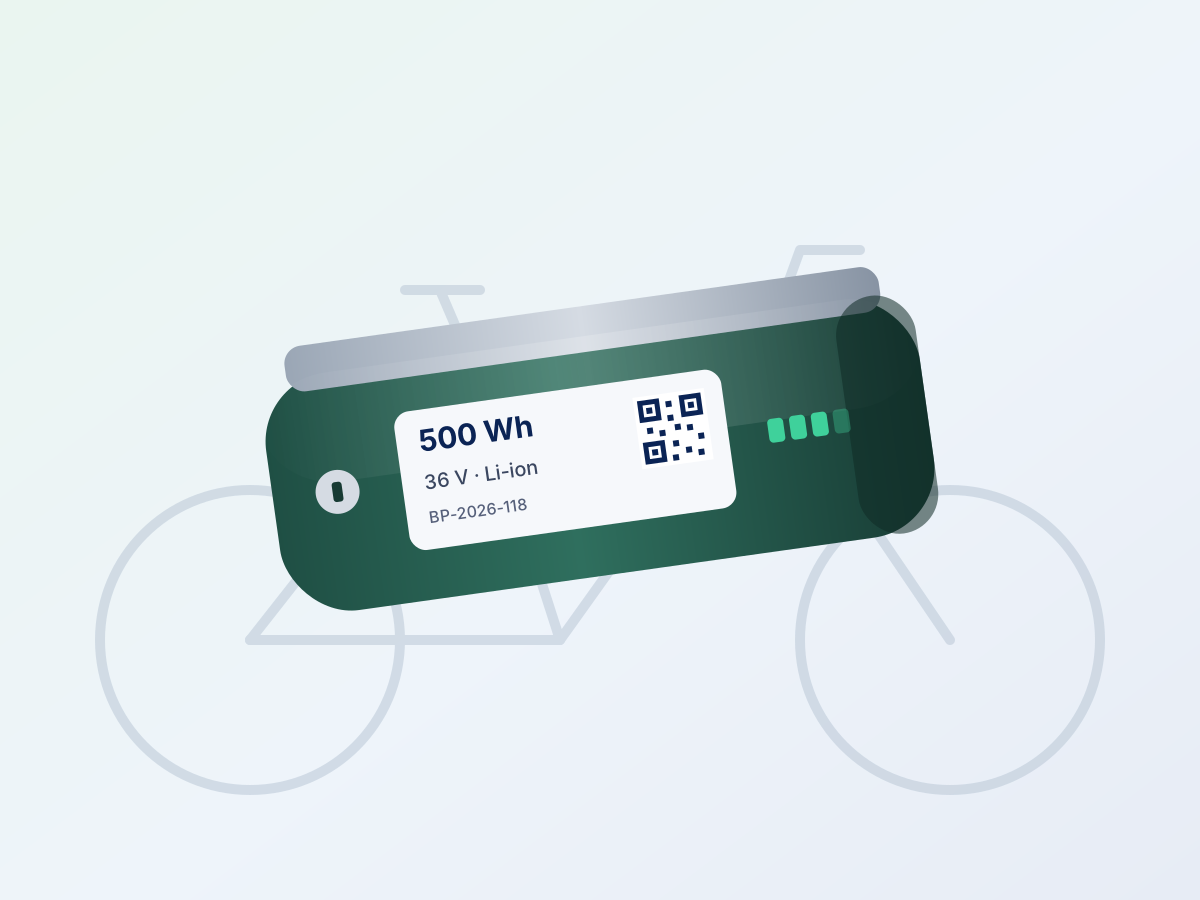
Illustration of an e-bike battery pack with a QR code on its label. Scanning the code opens its Digital Product Passport: E-bike Battery Pack 500 Wh, made in Germany, with a nine-step journey and reviewed evidence.

Industries

Built for physical products

Any product with materials, makers and a route to market has a journey worth recording.

  • Food & Beverage

    Coffee and cocoa traced from the farm plot to the roastery or factory, with origin records kept alongside the evidence behind them.

    For example: Origentra House Roast · Arabica · Huila, Colombia

  • Fashion & Textiles

    Fibre, spinning, weaving and sewing for each garment, with composition shown clearly.

    For example: Merino wool overshirt · 92% merino wool, 8% recycled polyamide

  • Consumer Goods

    Materials, makers and components for durable goods such as furniture, mattresses and tyres.

    For example: Oak dining chair · timber origin, finishes, assembly and repair information

  • Manufacturing

    Component lots, assembly facilities and test records behind each production batch, from batteries to steel parts.

    For example: E-bike battery pack · cathode materials, cells, pack assembly and testing

Use cases

What businesses use it for

The same connected record prepares you for new rules, protects your brand and keeps your supply chain honest.

  • Get ready for passport rules

    Battery passports from 18 February 2027, deforestation-free coffee and cocoa from 30 December 2026, with textiles and furniture next. Build the record once and publish when each rule applies.

    Use cases by sector
  • Make counterfeits easier to spot

    Passports live only on the official address, with identifiers that cannot be guessed and batch details customers can compare with the pack. If a QR code is copied, withdraw that passport in seconds.

    Counterfeits and passport misuse
  • Keep problem materials out

    Trace every batch back to the lots it was made from, record who held materials along the way, and require evidence for claims such as recycled content or deforestation-free.

    Substituted and illegal materials

See all use cases

Security and privacy

Private by default. Public by choice.

Supply-chain records include commercially sensitive details. Origentra keeps them inside your organisation and publishes only what you decide to share.

How we protect your data
  • Tenant isolation in the database

    PostgreSQL row-level security keeps each organisation’s records separate, even if application code has a fault.

  • Private evidence stays private

    Evidence files are served only to signed-in members of your organisation, through short-lived signed links.

  • Public passports from an allow-list

    Passports are built only from fields designated as public. Notes, prices and logistics references are never included.

  • Audit log

    Material actions, such as publishing a passport or changing a verification state, are recorded with who and when.

  • Hosted in the EU

    The application runs in Dublin and the database in AWS eu-west-1, Ireland.

Give every batch a story your customers can check.

Start with one product and one batch. Record where it came from, attach the evidence you already hold, and publish a passport when you are ready.

Need an account for your organisation? Contact us.